The 30-yard roll-off is the second-largest container Blue Collar Dumpster Rental drops in Philadelphia, sitting between the 20-yard ($695) and the 40-yard ($895). It measures roughly 22 feet long, 8 feet wide, and 6…
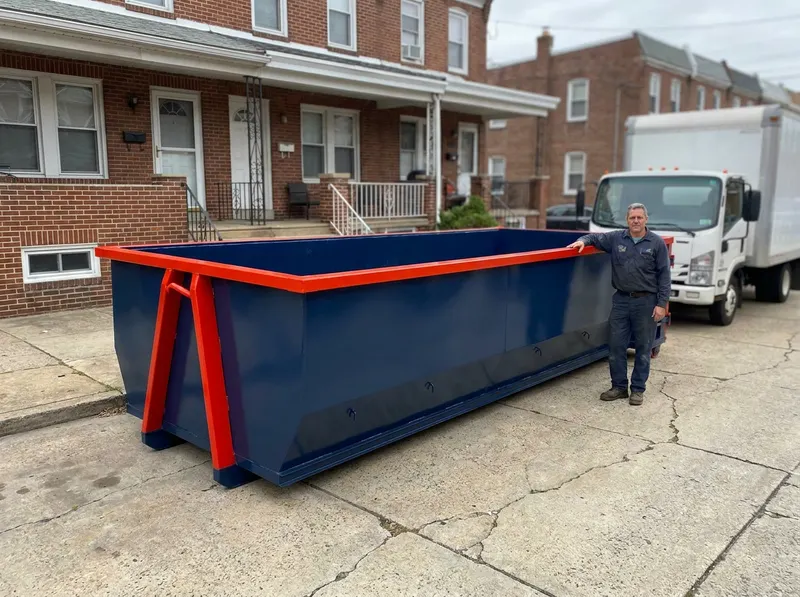
The 30-yard roll-off is the second-largest container Blue Collar Dumpster Rental drops in Philadelphia, sitting between the 20-yard ($695) and the 40-yard ($895). It measures roughly 22 feet long, 8 feet wide, and 6 feet tall, holds about 30 cubic yards, and swallows the equivalent of about 12 standard pickup-truck loads. That volume suits a full roof tear-off, a kitchen-and-bath gut, a two-car garage cleanout, or an estate clear-out where a smaller can would fill before the job is half done.
Choosing a size is a volume-versus-footprint decision.
A 10-yard ($595) fits a single bathroom remodel and tucks onto a tight Fishtown or Point Breeze curb; a 30-yard needs a driveway, a wide shared alley, or a reserved stretch of street because its 22-foot body will not sit on a narrow Manayunk or Port Richmond block without planning. If your debris is heavy and dense, think concrete, brick, or dirt from a South Philadelphia patio demo, a partially filled 30-yard is often smarter than overloading a 20-yard, since the flat $795 covers the weight either way. For light, bulky loads like a Germantown or Mount Airy attic and basement cleanout, the 30-yard's height earns its price by holding furniture, boxes, and bagged junk that a shorter can cannot stack.
Philadelphia logistics shape placement.
On row-home streets in Northern Liberties and Fairmount, a container set in the cartway requires a Streets Department right-of-way permit, and curb or sidewalk placement in the public right-of-way is governed by the Philadelphia Streets Department; a private driveway or a job-site lot needs no permit. Construction and demolition debris is the bulk of what fills these cans, and the EPA's guidance on C&D materials notes that wood, drywall, roofing, and concrete make up most of it. Roofing weight adds up fast, a square of asphalt shingles runs about 250 pounds, and the National Roofing Contractors Association is the trade authority on tear-off estimating.
Crews filling one of these on a jobsite should keep the load distributed and the path clear per OSHA construction standards.
Some materials cannot go in any roll-off. Wet paint, solvents, automotive fluids, and other household hazardous waste are excluded, as are tires, car batteries, and pressurized tanks; the City of Philadelphia runs drop-off options for these through its Sanitation and recycling services. Electronics are regulated separately, see the Pennsylvania DEP electronics recycling program, and much of what comes out of a cleanout can be reused or recycled, with local options searchable through Earth911.
Appliances with refrigerant, like fridges and AC units, have their own handling rules under the EPA refrigerant (Section 608) regulations. For anything mixed or uncertain, the Pennsylvania DEP keeps the waste-handling rules this hauling follows.
A 30-yard rental runs in five plain steps. Step 1: call (267) 347-7366 or text a photo of the pile and the street so the right size and the $795 total are confirmed before anything is scheduled.
Step 2: pick a drop-off day and a spot, driveway, alley, or a permitted curb length. Step 3: the roll-off is delivered, often same-day or next-day in Philadelphia County, and set with the door facing your work. Step 4: load it over your rental window, keeping debris level with the top rails.
Step 5: call for pickup and the container is hauled to the transfer station, with disposal already covered by the flat price.
Every job gets a firm, written price after an on-site visit.
Tell us about your 30-yard dumpster rental job in Philadelphia and we'll send a clear, written quote, usually the same day.
 Blue Collar Dumpster Rental